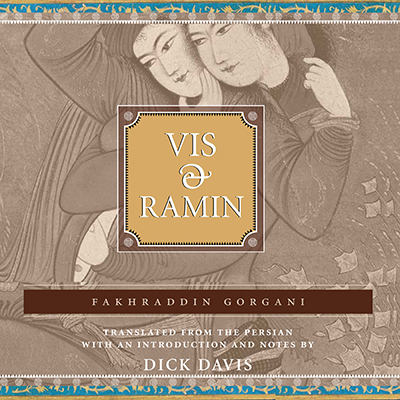
Vis & Ramin

Vis & Ramin is one of the world’s great love stories. It was the first major Persian romance, written between 1050 and 1055 in rhyming couplets. This remarkable work has now been superbly translated into heroic couplets (the closest metrical equivalent of the Persian) by the poet and scholar Dick Davis.

$24.95

Available

About the audiobook

Author:
Fakhraddin Gorgani; Translated by Dick Davis
Publish Date:
September 1, 2008
Languages:
English
Reader:
Mary Sarah Agliotta, Dick Davis
Time:
15 hours 24 minutes

Vis & Ramin is one of the world’s great love stories. It was the first major Persian romance, written between 1050 and 1055 in rhyming couplets. This remarkable work has now been superbly translated into heroic couplets (the closest metrical equivalent of the Persian) by the poet and scholar Dick Davis.

Vis & Ramin had immense influence on later Persian poetry and is very probably also the source for the tale of Tristan and Isolde, which first appeared in Europe about a century later.

The plot, complex yet powerfully dramatic, revolves around royal marital customs unfamiliar to us today. Shahru, the married queen of Mah, refuses an offer of marriage from King Mobad of Marv but promises that if she bears a daughter she will give the child to him as a bride. She duly bears a daughter, Vis, who is brought up by a nurse in the company of Mobad’s younger brother Ramin. By the time Vis reaches the age of marriage, Shahru has forgotten her promise and instead weds her daughter to Vis’s older brother, Viru. The next day Mobads brother Zard arrives to demand the bride, and fighting breaks out, during which Vis’s father is killed. Mobad then bribes to hand Vis over to him. Mobad’s brother Ramin escorts Vis to her new husband and falls in love with her on the way. Vis has no love for and turns to her old nurse for help….

Told in language that is lush, sensual and highly inventive, Vis and Ramin is a masterpiece of psychological perceptiveness and characterization: Shahru is worldly and venal, the nurse resourceful and amoral (she will immediately remind Western readers of the nurse in Shakespeare’s Romeo and Juliet), Vis high-spirited and determined, Ramin impetuous and volatile. And the hopeless psychological situation of Vis’s husband, Mobad, flickers wearily from patience to self-assertion to fury and back again. The origins of Vis and Ramin, are obscure. The story dates from the time of the Parthians (who ruled Persia from the third century bce to the third century ce), and certainly existed in oral and perhaps written form before the eleventh century Persian poet Fakhraddin Gorgani composed the version that has come down to us.
About the author

Very little is known with any certainty about Gorgani. His name suggests that he (or his family) was from the town of Gorgan to the east of the Caspian, and his frequent references to Gorgan in Vis and Ramin perhaps confirm this. He wrote his great romance, Vis and Ramin, in Isfahan, at some time between 1050 and 1055, when he was a member of the retinue of the local ruler.


About the Translator

Dick Davis brings a unique array of gifts to the challenges of translating Hafez and his contemporaries. In his own right, he is a poet of great technical accomplishment and emotional depth. He is also the foremost English-speaking scholar of medieval Persian poetry now working in the West. Numerous honors testify to his talents. In the U.K., he received the Royal Society of Literature’s Heinemann Award for his second book of poems, Seeing the World, in 1981; his Selected Poems was chosen by both the Sunday Times and the Daily Telegraph as a Book of the Year in 1989; and his collection Belonging was selected as the Poetry Book of the Year by The Economist in 2003. In the U.S., A Kind of Love—the American edition of his Selected Poems—received the Ingram Merrill prize for “excellence in poetry” in 1993. He has received awards for his scholarship from the Arts Council of Great Britain, The British Institute of Persian Studies, and the Guggenheim Foundation, and he is the recipient of grants for his translations from the National Endowment for the Humanities and the National Endowment for the Arts. Twice, in 2000 and 2001, he received the Translation Award of the International Society for Iranian Studies, and in 2001 he received an Encyclopedia Iranica award for “services to Persian poetry.” His translation of Ferdowsi’s Shahnameh: the Persian Book of Kings was chosen as one of the “ten best books of 2006” by the Washington Post.


Davis read English at Cambridge, lived in Iran for eight years (he met and married his Iranian wife Afkham Darbandi there), then completed a PhD in Medieval Persian Literature at the University of Manchester. He has resided for extended periods in both Greece and Italy (his translations include works from Italian), and has taught at both the University of California and at Ohio State University, where he was for nine years Professor of Persian and Chair of the Department of Near Eastern Languages, retiring from that position in 2012. In all, he has published more than twenty books and is a Fellow of the Royal Society of Literature.


Among the qualities that distinguish his poetry and scholarship are exacting technical expertise and wide cultural sympathy—an ability to enter into distant cultural milieus both intellectually and emotionally. In choosing his volume of poems Belonging as a “Book of the Year” for 2006, The Economist praised it as “a profound and beautiful collection” that gave evidence of “a commitment to an ideal of civilized life shared by many cultures.” the Times Literary Supplement has called him “our finest translator of Persian poetry.” In 2009 Mage published a book of Dick Davis’s own poems about Iran: At Home and Far From Home: Poems on Iran and Persian Culture. His book about the Shahnameh, Epic and Sedition was published by Mage in paperback in 2006. His books of translations are: Borrowed Ware: Medieval Persian Epigrams (1998), The Shahnameh (2004); The Legend of Seyavash (2004); Rostam: Tales of Love and War from Persia’s Book of Kings (2007); Vis and Ramin (2008); Faces of Love: Hafez and the Poets of Shiraz (2012).