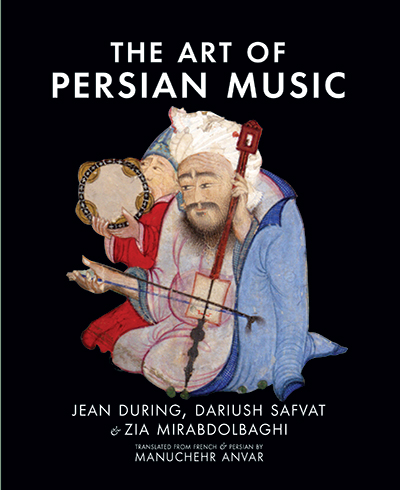
With lavish, colorful illustrations and a reflective text, the authors of The Art of Persian Music attempt to evoke the character of classical Persian music. The writers seek to combine the definition familiar to the scholar and teacher with the “vision” of the Persian classical music lover; they aim “at expressing what could be considered as most important by lovers of Persian music” (p. 13) in terms of musical aesthetics and relationships among Persian musics and other arts. Their threefold purpose is to provide “keys and definitions necessary for the overall understanding of the structure of Persian music,” to “define its aesthetics, ethos, spirit, and philosophy, through measured reflections and significant anecdotes” and to outline “the main historical trends and their evolution” (p. 13). Few musical transcriptions appear in the book, nor is there a great deal of analytical detail of any sort; the reader’s understanding depends on the textual referents and the music examples recorded on the accompanying compact disc.
The intended audience is one of nonspecialists. The authors address their work both to Western musiclovers and to expatriate Iranians “concerned about passing on the spirit of their traditions to their children” (p. 11). “With a view to this duality,” Jean During writes, “two complementary perspectives are juxtaposed in this book: on the one hand, an Iranian speaking of his own culture [Zia Mirabdolbaghi], and on the other, a ‘foreigner’ [During] trying to look at things from an outsider’s viewpoint” (p. 11). Thus the authors bring their long and rich experiences with Persian music to bear on the volume. During, a French musicologist known primarily for his work on Persian and other Middle Eastern melodic systems and on Sufi religious music, writes about the history and structure of Persian music, the relationship of poetry and music, and of music, mysticism and metaphysics. Mirabdolbaghi, an Iranian expatriate trained as an art historian who now teaches and performs Persian music in France, writes about music and the visual arts and presents an enlightening compilation of reflections about aspects of Persian music expressed by noted performers and teachers, entitled “The Master’s Viewpoint.” During and Mirabdolbaghi collaborate on a chapter on musical instruments, and the volume closes with a “lesson” given by Dariush Safvat, a multifaceted performer and master of Persian music.
The authors address themselves to the reader in subjective language using comparisons, metaphors, and analogies. For example, During writes of the feeling of playing classical music, “when the interpreter is submerged, as if possessed by the essence of the mode or the rhythmic cycle, imposing on him its own internal law, without his having the impression of being a voluntary participant in the exercise. His own performance becomes unpredictable to himself” (pp. 96-97). His description of rhythm is inventive and evocative:
Imagine a regular but hardly audible pulsation, such as the ticking of a watch, beating at the rate of, say, one pulsation per 1/2 second (the Ancients called this pulsation nagara). Along with some of these pulsations, we beat low percussion strokes (tom), and with others, high ones (bak). The ensemble of these percussion strokes constitutes a rhythmic formula that consists of, for instance, three, four, or five pulsations (called beat), or even many more (10, 12, 16, 24, etc.). This formula, reproduced in a recurrent manner, forms a cycle (dowr, osul, i/l’d), to which a melody is adapted. (p. 84)
Such language is colorful and suited to the introductory purposes of the book inasmuch as it captures the attention and imagination of the reader.
The changing perspectives among the authors and musicians whose views they quote and the subjective language of description admit complexity and even contradiction: for During (and indeed for many MiddleEastern musicians as well) melodic modes both do and do not bear associations with moods: “These general assertions [of mood] do not really interest musicians, for they adapt each mode to their own humor. However, it is obvious that when someone is asked to play or sing, he always tries to pick out the mode best suited to the circumstances and to his own mood (or possibly to the poem he proposes to sing)” (p. 77). Similarly, he acknowledges that the term gushe “is applied equally to materials that differ considerably in importance, in function and position in the system, and in form” (p. 79). This approach may encourage students to formulate their own questions, and the book offers information sufficient to provide a basis for further inquiry. The bibliography guides readers to more explicitly analytical materials.
The quantity and quality of the illustrations-including photographs of musicians and instruments, reproductions of Persian miniatures and contemporary works of art, and excerpts from classical Persian poetry-is an outstanding feature of the volume. Beautiful and evocative photographs of musicians appear (notably on pp. 136 and 138). The list of comparisons between Persian music and poetry (p. 161) is useful and the chart of types of Persian music (p. 25) has great explanatory value. The accompanying compact disc contains beautiful examples of the music with annotations (pp. 26065, reprinted on the leaflet included with the disc) that are easy to grasp.
Yet the evocative approach has its pitfalls, and in the volume at hand a few problems result from it. Readers may not always feel sure that they understand During’s meaning, for instance in the following description:
Sonorities of instruments are luminous, with priority given to the high register. Singers use mostly high pitches. In all registers, sonorities remain unnatural and very sophisticated, but finesse consists of not saturating in the intensity of sounds. There is quite a parallel between the use of colors by Persian painters and the balancing of timbres in music. The painter and the musician both go to great lengths to bring out the differences of timbre and shade, all within the limits of equilibrium. In the aesthetics of classical music, preference is given to sonorities that possess a certain richness in overtones, together with a resonance of long duration. These sonorities are called zangdar, an allusion to the tones of bells. (p. 195)
One thinks one follows During’s meaning, but, for lack of definition, one is not always sure; the comparison with the sound of bells is helpful but one wonders whether one shares his meanings of luminosity, sophistication, unnaturalness, and equilibrium or would recognize these qualities upon hearing them.
Some explanations are simply unclear. One questions both the accuracy and the validity of the dichotomies of “the ‘classical’ and the ‘popular’ (or folkloric), or between urban/rural or written/oral” with which the section “Musical Types in Iran” is introduced (p. 19). In the ensuing discussion the reader struggles to grasp the boundaries or contiguities of terms such as sonnati and mahalli and relationships between “categories,” “genres,” and “forms” (pp. 1923): the authors list two “genres” and then proceed to name at least five more. The reader is occasionally confronted with particular viewpoints in the guise of statements of fact: “In the Middle Ages, Oriental and Occidental music were very much alike” (p. 47).
Musical terms such as gushe and mava are used before they are explained (pp. 3334, 35). The word “mode” appears as a gloss for dastgah, avaz, and maye on the same page (p. 48). When their definitions are given (pp. 6063), the authors use a great number of technical terms, some of which may not be necessary for the beginner. These pages may well prove confusing to the uninitiated.
Generalizing about music in the “Islamic world” (p. 28) is always problematic, as the majority of Muslims live outside the Middle East. The theory that the Islamic concept of unity or oneness (towhid, p. 185) permeates musical expression and visual art is often unsatisfying: it is not easy to accept explanations of sophisticated and varied art as necessarily the manifestations of a single concept let alone to understand exactly how that concept influences expressive culture. Happily, the authors’ treatment of this idea remains gentle and suggestive, never insistent or pedantic.
The authors’ efforts are diminished by insufficient information at a few points. Many pictures appear without captions; the list at the back of the book does not identify all of them nor does it explain what the pictures represent, leaving interpretation to the imagination of a reader potentially influenced by popular (and often erroneous) stereotypes of the Middle East. Impressive paintings such as the modern work seemingly inspired by the fourteenth century poet Hafez (p. 159) cry for identification. Some illustrations are mystifying at first, for instance the photograph on page 18 which, upon comparison with others in the book, seems to be a view from the bottom of a tonbak (an hourglass drum). Relationships among pictures, such as details apparently of the same drum (p. 14, 18, 49, and 149) may be lost.
Poetic verses serving as captions for illustrations (and even the quotation of a “famous exhortation,” p. 154) are untranslated. The poetry is impressive and good translations would have increased the impact of the book (the quotation on page 122 is translated but bears no attribution). These sorts of omissions could easily have been remedied without disturbing the aim or the tone of the book.
The Art of Persian Music will best serve individuals and collections concerned with MiddleEastern musics, melodic systems, performance and improvisation, and relationships among the arts. It is valuable for the broad perspective offered by the authors and for its multitude of illustrations, unique in works on MiddleEastern musics. Instructors will find it easy to excerpt individual chapters for topical reading and this quality renders the book more useful than many.
Mirabdolbaghi’s “Masters’ Viewpoints” offers “a brief glance at certain aspects and ambiguities of traditional Persian music, as viewed by some renowned masters” (p. 201). In fact the entire book may be viewed as a suggestive introduction to “Aspects and ambiguities” of Persian classical music, and this is no minor achievement.